Showing posts with label Food and drink. Show all posts

Wednesday, 22 January 2014

Doña Cucha's Kitchen

Situated in the fertile breadbasket region in the heart of Bolivia, Cochabambinos get to enjoy the produce of the whole country: giant Andean corn on the cob, delicious sweet potatoes and yuca from the tropical lowlands, meaty surubi fish from tributaries of the Amazon, crunchy whole ispis from Lake Titicaca, grapes from Tarija, ... it's a paradise for lovers of good, natural food.

I lived with the Amestegui family for six months, during which time grandmother Doña Cucha was in charge of the kitchen from Monday to Friday.  Her husband is from La Paz, her daughter-in-law's family from Oruro, but she is a true Cochala in her roots - and her love of good food.

On the few occasions when I cooked for friends, I hid the supermarket receipts from her view.  She could have bought the ingredients much cheaper and probably better quality then I ever could as a gringo in the ferocious La Cancha, the city's huge market, the biggest in Latin America.  
The nerve shattering La Cancha Market

To be honest, I didn't learn much practical technique from her.  I think the idea that a foreign male could ever make a decent sopa de mani or plato paceño tickled her.  Anyways, I'd only have held her back.  Soon after breakfast, when I was starting Spanish lessons for the morning, she was already sitting in the sun peeling broad beans, pounding meat, simmering stock.

Bolivian meals, in the main, are quite simple.  Apart from a few of the hearty soups, most dishes are uncomplicated, with few creamy sauces or fancy accompaniments.  Surprisingly to many visitors, the national cuisine can be quite subtle - rice is gently cooked with a clove of garlic and a piece of green pepper, just to give a hint of the buen sabor.

For example, plato paceño (La Paz lunch plate).  A steamed cob of supersize Andean corn, pale straw-yellow and juicy; some broad beans, a cube of fried cheese, and an assortment of potatoes: a boiled potato, maybe a few ocas (like anyas), and (unfortunately for the uninitiated) chuños, blackening, freeze-dried potato cubes.

Another staple (mostly served on Wednesdays, I think) was plato cubano (Cuban lunch plate).  Rice was mixed with vegetables (carrots, peas), and topped with a fried egg and a few slices of fried plantain.

These dishes were brought to life with a teaspoonful of the fiery llajua, a hot salsa made of tomatoes, onions and the unmistakable bite of local aji chillies.


Now, in one respect, Doña Cucha was not the most typical of Bolivian cooks.  She aimed to make healthy meals, and used a fraction of the oil used in most Cochabamba kitchens, and less meat.  For me, her signature dish was quinoa 'lasagne'.  Her husband Don Lucho took great care to eat well as a preventative medicine.  Every second Bolivian you meet has had or needs to have their gall bladder removed, and/or has terrible gastric problems exacerbated by greasy meals.  So it was when I ate out that I tried the more gut-busting Cochabamba specialities pacumutu, silpancho, and pique a lo macho.

But when I reminisce about Bolivian food, it's Cucha's that I miss.

Looking back on those first six months in Bolivia, some of my happiest memories are around that dining table.  A family, united around traditional, home-cooked food.  All followed by a piece of tropical fruit for dessert (pink mango, chirimoya 'custard apple', pineapple, or papaya), a forceful café destilado, and a little siesta.

Lots of volunteers and missionaries go to Cochabamba to learn Spanish, and many end up staying.  They say it's the eternally spring-like climate that keeps them there - but what tempted me to stay longer was my stomach.



Tuesday, 21 January 2014

Chimichurri

This sauce will change your life!


Ingredients


  • 2-3 long red chillies, seeds removed, finely chopped
  • 10-12 garlic cloves, peeled, finely chopped
  • 2 large handfuls finely chopped curly-leaved parsley, leaves only
  • 4 heaped tsp dried oregano
  • 2 tsp sea salt flakes
  • 5 tbsp red wine vinegar
  • 4-5 tbsp extra virgin olive oil
  • 5 tbsp cold water

Method

1.  Tip the chopped chillies and garlic into a bowl.
2.  Add all remaining ingredients and stir well until combined.
3.  Cover with a sheet of cling film, and leave aside overnight for flavours to come together.

Serve on juicy steak!  (or anything else - chicken, fish, pizza ...)

Sunday, 10 November 2013

Baking for Theologians

'Reading Week' has just come to an end.

I've never actually had a reading week before, despite my rep as an eternal student.  To read or not to read?

I read.

Let me adjust your expectations of this blog post.  I'm not going to say anything theologically insightful.  I've had six weeks of theological boot camp, hardcore, abstract, mind-blowing stuff, no easy start building up in baby steps, but full-on Master's level philosophizing.  I'm exhausted!

So I have done what I often do when I need to escape the hamster-wheel of talking and listening, reading and writing.

I baked.

Because in baking, it's one egg or three.  Not three and yet one.

Whether you're an empiricist-fundamentalist or a post-modern relativist, 500g of flour means just that.  Easy.  Go on, contextualize the masculine literalness of number, I dare you.

Mistakes are made in baking, like getting your new Swiss roll tin lined, greased and filled with batter, only to find it doesn't fit in your oven.  Oops.  So you bake it in five minute intervals, open the oven and turn it at a different slant each time.  Worst case scenario - not inadvertent heresy - just a misshapen roulade.  I can live with that.

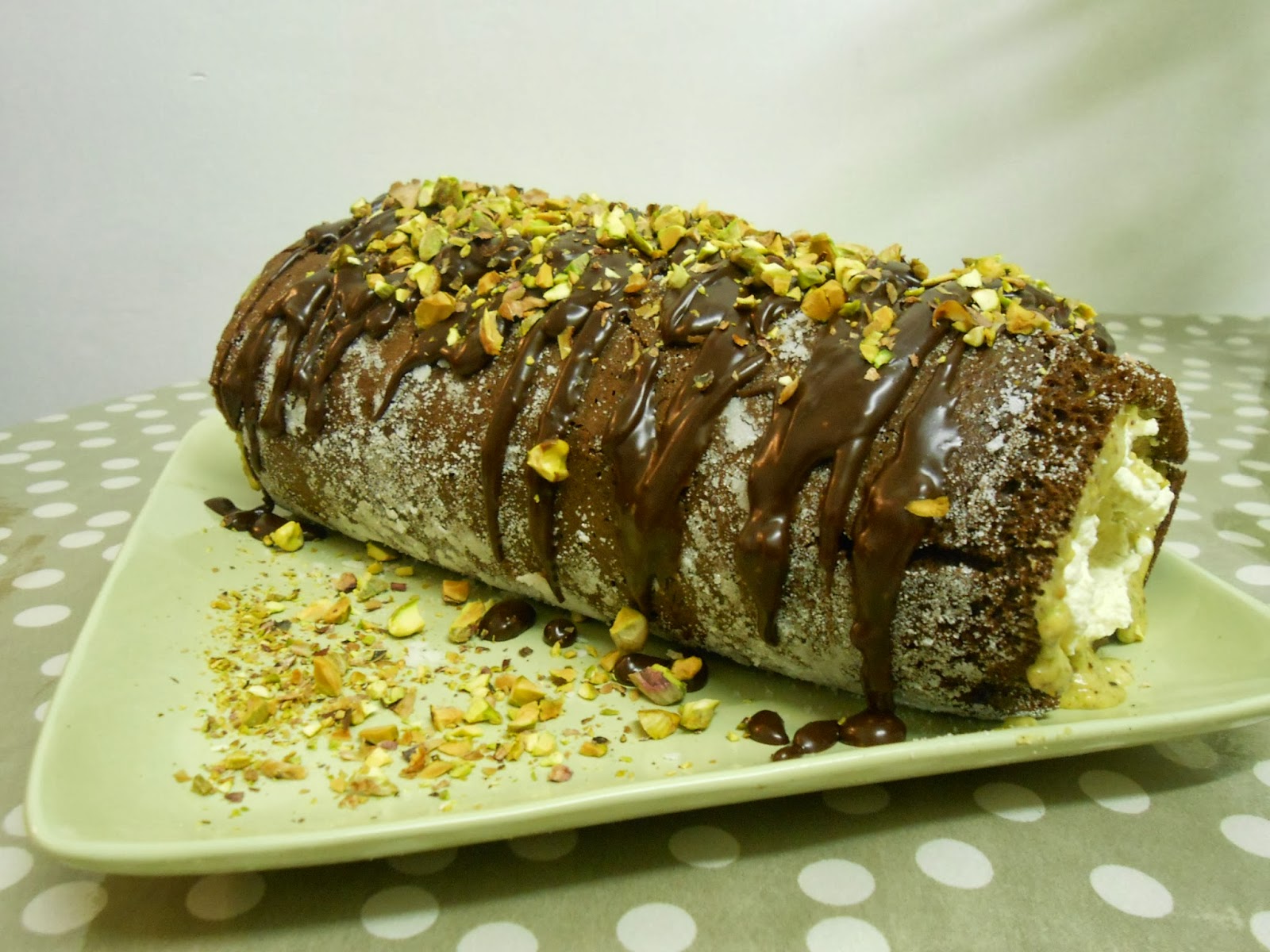
It's been a productive reading week.  I made spiced pumpkin soup, a lemon tart with a fun blackberry jelly layer on top, and a (misshapen) chocolate and pistachio cream roulade.

Man, it felt good to dissolve that gelatin sheet into the blackberry syrup.  I was following bullet point instructions.  Bliss.

Photographed from this jaunty angle, you'd hardly know it was baked at a 30 degree slant!

Lemon tart with a blackcurrant jam layer


Wednesday, 21 August 2013

What Would Jesus Eat?

Having recently blogged more on food than anything else, I was struck recently by Nigel Slater.  He didn't actually hit me, but the encounter left my head reeling a bit.
 
He seems to have written 20% of last Sunday's Observer, between his recent adoption of a rare breed of pig that he hopes to eat one day soon,
 
"despite its placid nature, its black patches and floppy ears, I'm not remotely attached to it, and am thinking only of its belly, chops and crackling"
 
and about 16 recipes for the likes of mushroom and blueberry pies.
 
One cookery show I don't watch is Slater's Simple Suppers.  In all honesty I find it a bit depressing.  A man wakes up thinking about what he'll eat that day.  His deepest conversations, indeed his only conversations, seem to be with the local greengrocer. 
 
In this programme, food doesn't invite friends and family round the table.  Instead, Slater sits dolefully gazing into the eyes of his sage risotto.
 
I sometimes feel a little embarrassed about how much I enjoy food - eating and cooking it, fair enough, but watching whole TV shows about it!  I suppose it has its place, and for me a very important place.  But to spend the day cooking for one?  (Apologies - smug married tone.)  In a grey London apartment, all minimalist, devoid of photos?
 
I think the reason I don't watch it is the fear that I, like many these days, could frighteningly easily become Nigel Slater!  Living to eat, pretty much.  (Sorry Nigel, I'm sure much of this is really unfair.  I'm using you as a metaphor for something bigger than you.  But you're a convenient and recognizable fit.  A psychologist would tell me this is projection or something.)
 
As an antidote, I have been reading some articles by David Grummett, Professor of Ethics and Practical Theology at the University of Edinburgh.
 
Grummett describes how food laws in the Old Testament actually limit the type and number of animals we humans can eat.  There are safeguards against factory-style farming providing daily meat with scant regard for the sacredness of animal life.  You can pretty much eat lamb and beef as an Israelite.  The vast majority of animals are not domestic and off-limits.
 
He also outlines how for Israel and, later, the Church, there were fast days and periods in order to limit food consumption.  Of course, people could enjoy feasts like Christmas - but after enduring an Advent fast. 
 
He talks of different fasts, mainly partial: one meal a day and a couple of collations (basically a cup of tea and a dry biscuit).  For centuries, Christians of most if not all shades considered gluttony as a serious sin, and refrained from eating meat on Wednesdays, Fridays and Saturdays.
 
The anti-nomian in me shudders at the thought of a Church telling people what to eat and when.  Yet my overly snug waistband and the ascending number of food-related posts on this blog are prodding me to think more about food and theology.
 
How come so much OT law concerns food?  (And so much NT teaching to, come to think of it, although NT material broadly concerns who with rather than what we ought to eat.)  What should I make of the vegetarianism of pre-flood human life?  The explicit torah on animal welfare and the link between sacrifice and slaughter?  The limitations on food types and combinations (meat or dairy, never both)?
 
'Food and drink' as a blog category isn't watertight, for as with everything, it could be labelled a post on theology.
 
So, for anyone who's interested, here are two articles by this food-theologian Grummett:

'Digesting the Word: a triptych and proposal on dietary choice', The Other Journal 19 (Fall 2011), 25–34
‘Christian attitudes to animals’, Compassion in World Farming website, March 2010


Monday, 19 August 2013

Adega Nova, Faro


I booked a room in Hotel Eva for two reasons.  The first was the location, minutes from Faro's historic centre and overlooking the marina.  The second was the hotel's roof-top restaurant, Haruna, which apparently had a famous chef and lots of awards.
 
We were very disappointed, then, when we got in the lift to the top floor restaurant and saw a freshly pinned-up notice: Hotel restaurant closed due to refurbishment. 
 
The receptionist was very helpful when we asked for a recommendation, but she was clearly emphasizing one eatery: Adega Nova.  So we went with that.
 
Past the bus terminal.  Along a couple of poorly lit streets, past shabby shop-fronts.  Had we gone wrong?
 
And there it was.
 
By the entrance were two glass cases with that morning's bright-eyed catch on ice, not a whiff of day-old fish.  We were shown to a section of a long cantina-style table and brought the ubiquitous bread and olives, but also some Portuguese cheese and ham, and a menu.
 
All around us were casks stacked to the ceiling, dusty bottles, and warmly-lit, oaky décor.  We had been transported to the old Algarve from times when Albufeira was a little fishing village - our waiter didn't speak a word of English - bliss!
 
The specials were hand-written on the first page, all twenty-odd of them.  Mainly fishy, there were a few meat dishes too.  And all very moderately priced, with mains ranging from 7 to 10 euro.  All written in Portuguese, I might add - we were the non-local minority that night.
 
The fish was tasty, fresh and perfectly cooked.  Served rustically, nothing pretentious, just fantastic Portuguese fare.  Sarah enjoyed the best piece of salmon she claims ever to have eaten.  My seafood medley in a winey sauce, not a million miles off paella, was served in a traditional copper pan, a hotchpotch of what was good and fresh that day: mussels, prawns, squid, fish.  The jug of vinho verde (green wine) helped it all go down very nicely.
 
We felt very privileged, on this most tourist-saturated of coasts, to find a little piece of Portugal, still in tact, attracting locals and welcoming the few lucky (plucky?) souls to venture away from the prettier quarters of town.
 
It was so good, we went back the very next night!  Who can turn down top-notch seafood for under ten yo-yos?  Although Sarah decided to give the Portuguese steak a go.  It was served raw, and a hot rock was provided, so she could cook the pieces to her own liking.  We were seated elbow to elbow with our fellow diners - this is a popular place and the hotel was obviously sending everyone here - and they politely pretended not to notice flecks of hot fat speckle their table mats and wine glasses.
 
How typical - the best meals of our 10 days in Portugal were the cheapest!  And in a jewel of a place that we found only because the one we researched was closed.

From November 2011
 

Wednesday, 14 August 2013

Top Kitchen Gadgets

I tend to get fun, kitchen, gadgety things for birthdays and Christmasses, mainly because I ask for them.  Over the years, we have all accumulated things that sounded great at the time, but ended up gathering dust in the utility room because they were just too darn hard to wash, or didn't actually save us that much time or effort in the end.
 
I'll never forget that juicer.  It took hours to take apart and clean, and even so there was still old fruit pulp hiding in the crevices ... eugh ....
 
The following five items are things that I actually use regularly, because they really do help more than they hinder.  I have chosen them based on the following criteria:

1.  They make life easier.
2.  They don't cost a fortune to use.
3.  They aren't impossible to wash up.


1.  Garlic Zoom
I don't know what I ever did before the Garlic Zoom.  Think Matchbox diecast toy car meets Nighmare on Elm Street.  Put a whole (peeled) clove of garlic in, zoom zoom vroom across the worktop like a toy car, and tip out finely chopped garlic.  Your hands won't smell.  A few bits will get stuck on the blade or in crevices, but a quick swish in warm soapy water is enough to get it clean again.  About £10 online.  Chef'n is a good (the original?) brand.  You'll still want to keep your garlic press for more pulverized garlic.  Otherwise, the job takes seconds, washing takes seconds.  Thanks to our friend and all-round kitchen queen Clare Higgins for introducing us to the Zoom.


2.  Mini-Chopper

I was dubious about this one, but it has convinced me.  Much smaller than a food processor, I wondered how well this little guy could do the job.  But he does, to perfection, every time.  Lemon zest, chilli, herbs, breadcrumbs, dressings, ... no trouble.  Cost us about £10 in a half-price Kenwood sale.  Much quicker to set up than the big food processor, this works in seconds and is washed in seconds.  Slightly too easy to break - ours is missing a few bits of plastic lock, but it still works fine.


3.  Mezzaluna
OK, so I wanted this at first because it looks cool.  But I have learned that it is useful too.  It came with its own wooden board, into which it slots for easy storage.  Excellent for herbs, and sun-dried tomatoes.  With some ingredients, especially if using them in more than small amounts, a mezzaluna is just easier than a knife.

4.  Hand grater
I have always hated standard graters, because the stuff gets stuck inside, and they are a nightmare to wash.  I can never get my hand inside properly.  No such middle-class problem with a flat hand-grater.  Excellent for nutmeg, parmesan, garlic, ginger.  So simple - who knew?!  The big grater is still needed for carrots, cheddar, etc. 


5.  Breadmaker
OK so this one was a wedding present from my sister and brother-in-law, and I know it costs more than numbers 1-4 combined.  But it features here because it makes it so incredibly easy to make delicious fresh bread with no chemical preservatives.  (You can use it to make jams and chutneys, various enriched doughs and stuff, but I haven't tried those.)  Recipes are easy - so long as you measure accurately, you are basically guaranteed a perfect loaf every time.  There are gluten-free settings.  You can programme the machine to have the loaf ready in the morning and wake up to the smell of fresh bread.  You can experiment and add seeds, herbs, cheese, garlic, tomatoes, olives ...  The making of the loaf takes approximately 3 minutes, and then the machine does the rest.  Washing = a quick wipe of the pan with kitchen paper. 


Monday, 15 April 2013

Easter baking

Sarah was really good all Lent and didn't eat any chocolate, so we needed a chocolate-free Easter treat for Saturday and a chocolately reward for Sunday.  So here are the results ...

Christus Victor Cake
I love simnel cake but nobody else I know seems to.  So here's a compromise between simnel cake's lovely marzipan top and a traditional Victoria sponge.  Watch you don't overdo the raspberry jam.  A Victoria sponge isn't the most macho of things to make, so I decided to butch it up and call it a Christus Victor cake ... but then I added some marzipan flowers.


I'm not going to claim credit for the basic recipe, it's Mary Berry's which you can find at http://www.bbc.co.uk/food/recipes/mary_berrys_perfect_34317.  However, I prefer to cream the sugar and butter, and then add the eggs, and then the dry ingredients, for a nice smooth mixture.  Sandwich together with whipped cream and raspberry jam.

On top, spread a little warmed apricot jam, and place a circle rolled out marzipan - as thick as you like!


Chocolately Hot Cross Buns
We made these gluten free, using Dove's Farm gf self-raising flour and adding a teaspoonful of xanthan gum for good measure.  They are not as hard to make as you might think.  I'd need to experiment with some vitamin C powder to try and improve the structure, as the gf version came out a bit dense.


Ingredients
2 x 7g sachets dried yeast
3½ cups plain flour (if gluen-free, add 1 tsp xantham gum)
½ cup cocoa powder
1 ½ tsp mized spice
1/4 cup caster sugar
350ml lukewarm milk
2 eggs, lightly beaten
1 cup sultanas
¾ cup good quality chocolate chips
½ cup currants

Crosses and glaze:
½ cup plain flour, extra
1/3-½ cup water, extra
apricot jam, strained and warmed

Method
  1. Combine the sifted flour, cocoa and mixed spice with the yeast and sugar in a large bowl. Add warm milk and eggs to flour mixture. Use a flat-bladed knife to mix until dough almost comes together. Add fruit and chocolate. Use clean hands to finish mixing to form soft dough.
  2. Turn out onto a lightly floured board and knead until smooth and elastic. Return to bowl, cover with plastic wrap and leave in warm place for 1 hour or until doubled in size.
  3. Punch down dough to its original size. Knead until smooth then divide into 12, shape each portion into a ball, then place onto a greased tray about 1 cm apart. Cover with plastic wrap. Set aside in a warm place for 30 minutes or until buns double in size.
  4. For the crosses: Mix extra flour and water together in a small bowl until smooth, adding a little more water if paste is too thick. Spoon into a small resealable bag. Snip off 1 corner of bag. Pipe flour paste over tops of buns to form crosses. Bake in a moderately hot oven 190°C for 20-25 minutes or until cooked when tested. Glaze with strained apricot jam.  Allow to cool on a wire rack.


Sunday, 20 January 2013

Cedar

We had a fantastic experience at Derry's newest restaurant last weekend.  Cedar is a Lebanese restaurant on Carlisle Road which opened a couple of months ago.  We had only heard excellent reviews, and were very  excited to try it out for ourselves.

Staff welcomed us and took our coats, and got us settled at a table with mismatching glasses and crockery.  It's a small wee place, cosy and intimate, where you feel like you're on holiday ... maybe in Lebanon, maybe in London's Greek Street.

Our party of five chose the chef's recommendation.  I can't remember the Arabic word for it (hafli?), but am pretty sure it translates along the lines 'massive banquet with a bit of everything'.  We got to choose a selection of cold and hot mezzes, to be followed by a mix of meats and rice and Lebanese desserts.

The mezzes were delicious: my own favourite, stuffed vine leaves, were fresh and zingy; our Moroccan friend thought the falafel was the best he'd tasted outside North Africa and the Middle East.  A surprise hit was the baked okra in a rich tomatoey, oniony sauce.  Something for everyone, including vegetarians and coeliacs.

Our main course (part of the set banquet) didn't sound exciting - there were far more exotic sounding things tempting me on the main menu - but this is where chef Simon's skill shone.  Each of us had three skewers, chicken, lamb and beef, with various dips.  Now a chef who can make chicken taste this good, and turn rice into something this delicate and aromatic (almonds?), is worth supporting with your trade!

Those who had coffee concurred it was good, and the deserts went down very well.  As well as the expected baclawa, there was a delicious avocado mousse.  Sarah offered me hers as the other desserts were pastry-based, but she changed her mind when she heard the rest of us make noises of appreciation - mmmmm.

Cedar gets full marks from me for its food.  But the experience was as much about hospitality.  Bernadette and Claudia made us feel like honoured guests with their attentive service and great chat and humour.  Chef Simon joined his family toward the end of the night (sorry we really were those guests that never leave) to make sure we'd had a good time, and tell us how they came to open their restaurant in Derry.

Now, if you live in or visit the city of Culture, please go to Cedar.  The pattern in Derry, too often, is that exciting new places open up and do well for a while and then shut again.  But we need restaurants like Cedar to give us real variety and choice.  No tobacco onions, no garlic potatoes ... so totally different to most other restaurants in town.  Vive la différence!

Thursday, 13 December 2012

Four Chocolate Fondants

Three years ago (Sarah says it's more), I promised to make her chocolate fondant.  I used some friends to practise on, and served them some nice, if heavy, individual chocolate cakes.  I was beaten.

Three years (or over) later, Sarah was poorly and I decided chocolate fondants were the cure.  It was time to face my nemesis.

The trick, they say, is the preparation of the ramekins.  Upward strokes of melted butter, chill, repeat.  Mixture is at the right temperature and comes out easily.  You don't want to take any risks with these tricky little buggers.

An added challenge... this week is Masterchef final week.  So I am feeling all cheffy and inspired!

Fondants one and two: I make a batch of four, although I use an extra few dozen bowls and utensils to make one fondant gluten-free.  The GF fondant struggles to find its legs, but tastes yummy.  Looked a mess though.  I'll have to experiment with adding xanthan gum or vitamin C powder or one of those faffy ingredients that makes GF baking vaguely possible.  Sarah's, however, slid effortlessly onto the plate, held up strong with all that gluten no doubt, and score!  The centre was gooey and oozed out all over the plate in a very pleasing way.

Fondant three: If this were Masterchef, how could I ponce about with this recipe and impress Michel Roux?  I know!  Cut out some paper stars, add strawberries cut into flowers, and dust with icing sugar.  Fondant wobbles menacingly tonight, so it gets an extra one minute in the oven.  Capricious things, they are.


Fondant four: Out of strawberries.  What have we got?  Aha, tonight is clementine and pistachio night. Peel and de-skank clementine segments, make a wheel shape, and throw over a few salted pistachios.  Dust with cocoa powder.  Sorted.  Fourteen and a half minutes - that's what they need in our oven.  Maybe it's the big ramekins.

Next time: how can I booze them up with a good glug of brandy?

Oh, and Sarah is feeling much better, if a little full.  But she has requested no chocolate fondant for dessert tomorrow.


Wednesday, 28 November 2012

Martine's, Galway


"Martine's Heart Coeliacs", says the menu. 

I Heart Martine's, too.


We arrived at the bar downstairs, waited for a small throng in front of us to be turned away disappointed, and proudly announced that we had a reservation.  We were immediately shown up an unglamourous staircase ('Oh rubbish, they're going to stick us in the overflow') into an intimate, low-lit space ('Score!').  Offered our choice of table, we selected one at a jaunty angle to the bay window so both of us could look down onto colourful Quay Street.  Our coats were taken from us, and we were left comfortably to ponder the menu as well as some fun art by Martine herself.
 
In Galway, you just have to go for oysters.  Shunning the baked alternative, I went for six plainly presented Galway Bay oysters, served with parsley and a wedge of lemon.  These bad boys were fresher than fresh, barely a briney scent; they tasted minerally and then sweet and perfumed.  I was in heaven.  Sarah had the chicken liver pâté, which she awarded a confident 8/10.
 
Martine's excels in both turf and surf.  Cuts of steak and catches of fish vary daily, and are displayed on a chalk board.  Our waitress recommended the cheapest fish dish on there, wild plaice, for its buttery, flaky flesh - and man alive was she right.  Served on a bed of mushroom risotto, it sang an uncomplicated but beautiful solo.  'For research purposes', I sampled Sarah's steak - robust flavour and cooked perfectly, served with sweet slow-cooked onions - and chips - earthy, chunky, golden, a solid B+ grade from a tough marker.
 
Filling fare to restore and comfort at the end of a frosty day's exploring the West.  No dessert required (the bill was presented along with mini chocolate brownies), but we enjoyed a glass of wine each.  Sarah had an easy-drinking French Les Jamelles 2010 Merlot, and I surprised us both by opting for a crisp, dry Italian with a name I can't remember.  Very decent wine list. 
 
All in all, a quintessentially Galwegian dining experience: friendly, self-assuredly Irish with a Latin twist, top-notch local produce from land and sea, and memorable for all the right reasons.

Martine's menu is mostly coeliac-friendly or can be made so with a few minor tweaks.  Staff are helpful and knowledgeable about gluten-free food.  Highly trustworthy and coeliacs won't feel limited in their menu choices.

Starters €5-12, Mains €12-30, Wine by the glass €5-7.50  (Lunch menu also available)
www.winebar.ie  21 Quay Street, Galway, Ireland  00353 91 565662


Sunday, 2 September 2012

Great Birthday Bake-Off

It was Sarah's birthday last month, and we had a few friends around for afternoon tea (actually more like evening time, so it was pretty much cake for dinner!)

My birthday present to Sarah was to make a plurality of cake for her party, and since some people asked for the recipes, here they are ...

Blueberry and lime cheesecake gateau


1.  Blueberry and Lime Cheesecake Gateau

Ingredients
- 225g self-raising flour
- 1 tsp baking powder
- 200g caster sugar
- 200g butter (room temp or softened)
- 4 large eggs
- 2tsp vanilla extract
- 1 tbsp milk

For the frosting and decoration:
- 400g medium-fat ricotta
- 100g icing sugar
- 200g blueberries
- grated zest of 2 limes and juice of 1

Method
1. Pre-heat oven to 180C.
2. Beat together flour, baking powder, sugar, butter, eggs and vanilla.
3. Whisk hard while adding ilk.
4. Bake in two deep 18cm round cake tins for 40 mins.
5. Cool, then split one or both sponges in two.
6. Beat the ricotta until soft, then beat in the lime zest and juice, and the icing sugar.
7. Sandwich the sponge layers together, spread remaining frosting on the top, and decorate with blueberries.


2.  Raspberry Scones

Ingredients
- 225g self-raising flour
- 1 tsp baking powder
- 1 heaped tsp caster sugar
- 50g butter, diced
- 200 ml buttermilk
- 100g raspberries
- clotted cream, to serve

Method
1. Heat oven to 220C.
2. Sift flour and baking powder into a bowl, and stir in the sugar.
3. Rub in the butter to resemble breadcrumbs.
4. Make a well, add buttermilk gradually until it forms a soft but not too sticky dough.
5. Push raspberries through the dough with your hands.  They'll break up, but that's OK.
6. Tear the dough into six clumps and shape roughly.
7. Bake on a floured tray for 12-14 mins.
8. Cool on a wire rack.


From left to right:  millionnaire's shortbread, chocolate toffee brownies,
cheesecake buns, raspberry scones, and almond lemon shortbread


3.  Almond Lemon Shortbread

Ingredients
- 250g butter, softened
- 140g golden caster sugar (plus extra for sprinkling)
- 1 large egg
- 1 tsp vanilla extract
- zest of 2 lemons
- 300g plain flour
- 100g ground almonds
- a little milk to brush and seal
- 3 tbsp lemon curd
- flaked almonds

Method
1. Heat oven to 190C.
2. Beat together butter, sugar, egg, vanilla, zest and a pinch of salt.
3. Fold in flour and ground almonds.
4. Roll out on a flat surface to the thickness of a £1 coin(on a warm day, chill in the fridge first). 
5. Cut out rounds with a 7cm cutter, and brush with milk.
6. Spoon blobs of lemon curd on half; the remaining disks are the tops.  Gently press to seal.
7. Sprinkle with caster sugar and flaked almonds.
8. Bake for 15 minutes.  Cool on a wire rack.


4.  Millionnaire's Shortbread

Ingredients

For the biscuit base
- 140g butter, cold and diced
- 175g plain flour
- 25g cornflour
- 50g golden caster sugar
- 85g blanched almonds, toasted and chopped
- seeds from 1 vanilla pod

For the caramel
- 200g golden caster sugar
- 140 ml single cream
- 50g btter, diced

For the topping
- 200g dark chocolate (70% cocoa solids)
- 85g butter

Method
1. Heat oven to 160C and butter a shallow 20 x 23 cm baking tin.
2. Sift flours into a bowl, and add sugar, almonds, and a pinch of salt.
3. Run in butter and vanilla seeds.
4. Press firmly into the tin.  Freeze for 5 mins, then bake for 35 mins.
5. For the caramel, put sugar and 100ml water in a heavy based pan.
6. Heat gently until the sugar dissolves, then turn up the heat and boil until it goes dark amber.
7. Add the cream a little at a time, stirring all the while.  Take care, it will hiss and fizz!
8. Add the butter and half a tsp salt.
9. Pour over biscuit base and let cool.
10. For the topping, melt chocolate and butter together and smooth with the back of a spoon.
11. Cool and cut into slices.

5.  Chocolate Toffee Brownies

Ingredients
- 350g dark chocolate (70% cocoa solids)
- 250g butter
- 3 large eggs
- 250g dark muscovado sugar
- 85g plain flour
- 1 tsp baking powder

Method
1. Heat the oven to 160C.
2. Butter a shallow 23cm tin.
3. Melt chocolate and butter. Allow to cool slightly.
4. Whisk eggs until pale, combine sugar.
5. Fold chocolate mixture into the egg and sugar mixture.
6. Sift in flour and baking powder, and combine.
7. Bake for 30 minutes.  Mixture will be gooey but will solid up when cool.
8. Cool in the tin on a wire rack for at least one hour.

6.  Individual Cheesecake Buns

Ingredients
- 100g butter, room temperature (or softened)
- 100g golden caster sugar
- 2 large eggs
- zest and juice of 1 lemon
- 140g elf-raising flour
- 50g blueberries

For the topping
- 250ml soured cream
- 30g icin sugar
- 1 large egg
- 1 tsp vanilla extract

Method
1. Butter a 12-hole muffin tin.
2. Cross 1.5cm strips of baking parchment in each hole.  Make sure ends stick up, so you can lift the cakes out after baking.
3. Heat the oven to 180C.
4. Beat butter and sugar together until pale and creamy. 
5. Gradually beat in the eggs, then lemon zest and juice.
6. Fold in the flour.
7. Divide among muffin holes, smoothing over the tops.  Sprinkle 3 blueberries on each.
8. Bake for 12 mins.
9. Meanwhile, whisk topping ingredients together.
10. Remove muffin tray from the oven, and press down the risen sponge with the back of a spoon.
11. Spoon topping on each sponge base and scatter with remaining blueberries.
12. Bake for a further 5-7 mins.

Monday, 18 June 2012

Cheese

It's not a metaphor.  It's just cheese.

We were in Dublin over the weekend, and I should be writing about running or something cultural, but I'm writing about cheese.

Sarah and I went to Sheridan's Cheesemonger's in Anne Street South.  They made us an amazing four-tiered cheese cake (i.e. cake of cheese) last year for our wedding and shipped it up to Co. Donegal for us.


How many French cheeses can you name?  How many Italian?

Now in an island with this number of sheep and cows ... how many Irish cheeses can you name?

Our little traditional producers are finding it tough to beat the commercial competition.  We must be the only nation in Europe where most people can't name a traditional cheese of our own.  So let me introduce you to four smelly friends ...

First, we have Mount Callan, an aged cheddar-style hard cheese from Co. Clare.  It's made of milk from a single herd of Montbelliard cows.  It's very sharp, take a bite, chew ... wait for it, wait for it - boom, tastes boozily punchy.

Then we have Ardrahan from Co. Cork, oat-smoked and soft, it's a washed cheese which means it's smelly and oozy and yummy.  Despite the whiff, the Corkonian actually tastes quite mild and nutty.

Next up, we have Crozier Blue from Tipperary.  Like it's cow's milk cousin, this ewe's cheese is veined with dusty blue mould, tangy and ripe, bathed in a creamy soft meltedness.  It's a Gaelic Roquefort.

And to finish it off, then there's a cheeky little St. Tola sitting on top, a French-style soft goat's cheese, again from Clare.

But try getting any of these in Tesco, Temple Bar or Sainsbury's here in Derry!  Or anywhere in Derry, for that matter.  So when in Dublin, we just had to drop into Sheridan's to reacquaint ouselves :)

So, support local produce, learn that Ireland has fantastic cheeses to rival France and Italy, and give those arteries a good work-out, visit http://www.sheridanscheesemongers.com/.

Now to research local Irish beverage-producers!

Saturday, 2 June 2012

Kitchen Table

Welcome to my blog!  I've been talking about starting a blog for a very, very long time.  It's a four-day weekend so I reckon the time has come to commit words to screen.  I feel OK about it, because there's an edit button.

I'm sitting in one of my favourite places, at the kitchen table.  Sarah and I have decided that we are getting into a rut with the meals we cook.  So, we are flicking through Rick Stein's Spain, Nigella's Feast, and some of my many low-GI, wheat-free, lentil-centric cook books, for new ideas.  By the way, the hippy-style cook books are there more to make me feel better than to be used day to day!

So far we have decided to eat more prawns, and that we want to make lots of recipes.  But still no shortlist.  To make the choice easier, we are automatically discounting all recipes that have no accompanying photo.  I'll let you know how we get on!

Anyway, I'm not just here to tell you about our lazy Saturday morning.  Gosh, I'm not doing very well at not making this blog post self-indulgent.  That's not meant to be the point at all.

I suppose I'll only know myself once I get started what I decide to talk about.  I predict food will feature significantly.  Hopefully travel will too.  And if all goes to plan, as a born-again runner (used to run, took it up again in February this year and have kept it up because I was obedient and followed the plan unlike all previous attempts the past 4 years), I hope to be brave enough at some point to say out loud what distance/event I am aiming for.  If you think it's a marathon, please lower your expectations ... by about 50%.

And I expect a lot of my rants and raves will be about the 'state of the world'.  I often rant about apostrophe use and the like, but you probably wouldn't be reading this now if the last paragraph had been about apostrophes.  So I'll try to refrain.

I'm doing a course at the moment called 'Christian Ministry' with the Church of Ireland Theological Institute in Dublin and St John's Nottingham.  That's what really made me want to start a blog, actually.  It's a brilliant course, and makes me think about a lot of things.

So if you would like to talk about any of them with me, thank you for stopping by, and please feel free to keep me accountable about the running, to ask me to tone down the rants, and to have a chat about the big issues and small ones too.

OK, got to get back to my cook books.  Chat soon!