Showing posts with label Travel. Show all posts

Monday, 13 May 2013

Praying in South Africa

Our recent holiday was good for our prayer life.

We prayed for reconciliation and healing at St. George's Cathedral in Cape Town, with a multicultural, multilingual congregation, in the same sacred space where Archbishop Desmond Tutu decried the heresy of apartheid.

That was pretty special.

We prayed spontaneous doxologies when zebra, giraffes and elephant wandered across our path in Hluhluwe-iMfolozi, when we saw the stunning sunrise over King Shaka's old hunting ground, and when we reached the sun-bleached Cape of Good Hope where Atlantic and Indian Oceans meet.

And we prayed and prayed when we broke down by the side of a busy road!

Before our safari, we had a blow-out on the main road.  Lucky for Clare, Hannah and myself, Sarah is an expert tyre-changer.  In a mere 10 minutes, we were back on the road, making a detour to nearby Mtubatuba which from what we saw was a mainly Zulu town consisting of garages, fried chicken places and street kiosks.  It was Saturday mid-morning, and market day was winding down.

The garage owner smiled apologetically.  "It's a Chevy Spark.  We don't have a tyre that size.  Nowhere will.  We could have it here by Tuesday."

So, we took the risk of a two-day game drive on gravelly paths punctuated with regular potholes, praying the whole time that we'd be OK.  We did not want to get another flat in the middle of Mfolozi Reserve.  We could get eaten by lions!

On Sunday afternoon, having seen three of the 'Big Five' and lots more, we drove on to St. Lucia hoping to see hippos and crocs, but they were hiding.  So homeward we went ...

Until we sensed deja vu, the rasp of rubber on road, the unsteadiness of the metal encapsulating us, ... another blow-out.  And for no apparent reason, no nail, no glass, just a massive hole in the tyre.

And no spare.

Now, you don't want to hang around the side of a road in South Africa (nor anywhere else really). 

The breakdown people could tow us back into Mtubatuba, but everything was shut there, and we knew it would take a few days to get another tyre.  Clare called friends back in Durban, who called friends of friends closer to where we were, and soon we had an old Afrikaans couple with us.  He had brought a few spare tyres in assorted sizes in case one might do, but no such luck. 

Meanwhile, his wife rang around her friends and neighbours.  In earthy, guttural tones, she seemed to be asking, 'You know that young girl, lives above the liquor shop down the street from you, parks behind the garage, is it a Chevy Spark she ... oh.  A Micra.  Well, what about that man from ...'.

Sarah had a brain wave.  She decided to look for a Chevy Spark and flag it down and offer to buy their spare tyre.  Now it's not the commonest of cars, but within a few minutes there one came - no, it's a - yes, it's a - no, that's a - yes! yes! a Chevy Spark! STOP!!!

It drove on past.  A woman at the wheel, three daughters with her.  There was no way women would stop on a South African road when flagged down by strangers.

And then, our little miracle happened.  The Chevy slowed down and pulled over, turned around and approached us cautiously.  This woman must be crazy, we could be anybody!  We could do anything!  This was a country infamous for car-jacking and violent crime!  Yet, she stopped, yes she'd just had some new tyres put on, yes she had a spare.  She said she didn't want to exploit the situation, she'd take 200 rand - Clare knew it was worth at least 500, paid that, and gave her details in case the replacement was more.

In minutes, we were roadworthy again.

During all of this, we were praying like mad.  Not pretty, considered prayers either.  Prayers along the lines, Oh please please please God, get us home!  We don't want to spend three days in Mtubatuba!  Please don't let anything happen to us!  We're scared!

I think we realized, far from home, with no ATM close by, in a foreign country, knowing these highways were used by bandits and car-jackers, that we couldn't help ourselves.  We weren't self-sufficient, we needed help from up above.

Richard Foster's book 'Prayer' (does what it says on the tin) surveys many kinds of prayer: intercession, praise, praying during the long night of the soul ...  But he begins in chapter one with 'simple prayer'.  Immediate needs (and wants).  He says if we can't start with childlike prayer, we won't progress to more spiritually advanced prayer. 

Our experience in South Africa reminded us of our need for simple prayer.  And it's absolutely compatible with Christian faith, including mature faith: God concerns himself with our lives, including little details, and he acts providentially as a result.

Providence is a philosophical minefield, but we aren't asked to reconcile conflicting strands of logical dialectics; we're just asked to have faith in our Father who cares for us.  And, on the main Mtubatuba to St. Lucia Road in kwaZulu-Natal,  he certainly did.

Safari

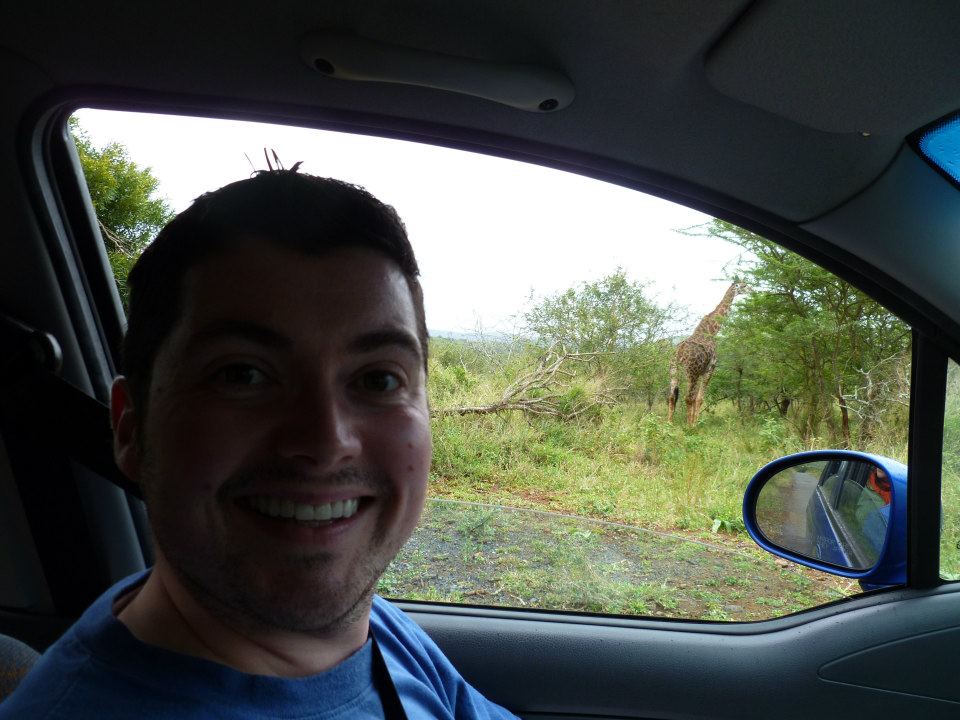
Giraffe on safari spots rare Irishman

DAY ONE: MFOLOZI

I was reduced for two days to my five-year-old state.  I was going to see animals in the wild!  We were going for two days to Hluhluwe-iMfolozi Reserves in South Africa!
I had been well warned, as is appropriate with all five-year-old boys excited to see animals - that I was not to set my expectations too high, just in case.  Wild animals do not perform on cue.
We had a picnic lunch and a good stretch just outside the park gates, knowing it would not be wise to open the car door for several hours thereafter.  Then, with binoculars, camera and wildlife guide in hand, we left the road, past the triangular sign depicting lots of dangerous hazards like lions and crocodiles, and officially entered The Wild.  Grrr!
Hazard symbols not found in
the Northern Ireland Edition
of the Highway Code
The reserves we visited were Zulu King Shaka's old hunting ground, and we soon lost sight of the perimeter fence and were in a landscape completely empty of power lines and rondavel houses.  The reserve is hilly and mostly forested with open savannah in places.  Africa!  My inner five-year-old could barely contain the excitement.
Twenty minutes in, we came across a car stopped near the hillside.  Clare pulled up and asked if they could see anything.
"Look, way over there, on the other hill, there's a rhino!"
My three companions saw it, just about, but I could not see any rhino, either with or without binoculars.  OK, maybe I could - but equally it could be a twig, or a stone, or a speck of dust on the lens.  My heart sank.  Was it going to be two days of convincing myself that an ambiguous shadows were in fact the Big Five?
And then, four zebra casually strolled across the path in front of us.  So close we would have noticed if they had fleas!  Beautiful, stately beasts despite nicks in their ears, rough patches of skin, a few surprising pock marks and bull's licks in their pelt.  Not picture perfect, better than picture perfect.  Wild!  Grrrrr!
Soon after, we met a family of warthogs, every bit as comical as Pumba in The Lion King, but even uglier and yet sweeter.  And not even the littlest hoglets seemed at all perturbed by the Chevy Spark inching past them.
Bam.  That's how these game drives are.  There was less gradual dawning of what was there and more 'BAM look it's a rhino'!  (A white rhino, to be precise).  Massive, just behind a scrawny tree.  The horn was longer and pointier than I expected, the beast more tank-like.  We stopped, awe-struck.  This was a legend.
Clocking us
He clocked us.  We froze; the blood drained downward to help our feet run, but we just had to hope the Chevy's frame was thick enough to take a two-and-a-half rhino horn - obviously it wouldn't.  He looked away ... but of course with eyes on the sides of his head, he was perhaps only now sizing us up. 
We drove off very, veeery slowly ...
As we continued deeper and deeper into Mfolozi, we saw a good number of bok (steenbok, springbok, kudu), water buffalo, and some incredibly colourful birds such as African hornbills (aka Zazu from the Lion King, hitherto my main source of knowledge about the African Continent) and icky vultures.
Alas, it was time to turn around.  In South Africa it gets dark early, and it gets dark quick.  I pressed for a last little look by a watering hole, a short detour here or there, in case we'd spot something else exciting, but nada.
Hope faded as we approached the park gate; we only really knew how close we were getting based on the time it had taken us to drive to the furthest point reached.  Hardly likely to see anything really big as we got closer again to civiliz.....
BAM!  Giraffe.  Close enough we could almost have leaned out of the window and touched him.  He looked old, his knees were knobbly and leathery, but he was agile enough to strain and lick foliage clean off the topmost twigs of the trees. Big eyes, graceful gait, we were transfixed.  He walked off at his leisure, craning his neck this way and that as if posing for the camera.  Jolly decent of him.
Stately - a lone giraffe
BAM!  Another?  It's ... !
Our cognition took a few seconds to catch up with the sight in front of us.  An elephant.  A big, brown, furrow-skinned elephant, just 20 metres ahead.  There had been occasional signs warning not to get any closer than 50m, but we didn't exactly choose the location!  Another car was just ahead, between us and this most spiritual of animals.  Clare told us of an article she'd read a week ago, about a car of Japanese tourists flattened by an elephant. 
He scratched his itchy head against a tree.  The tree came off worse.  He shook his head from side to side, flapped his ears, and the dust flew in all directions.
Awe.  This was one mighty beast, peaceful and serene but powerful.  Good, but not safe, as the Narnians said of Aslan.
Whether or not dusk was approaching, we just had to wait for him.  Eventually, this majestic beast stepped off the path and slowly disappeared into the trees.  I think no one spoke for a while.  Clare started the ignition and we rolled off in silence.
Not safe but good - we hope!
We came to the fork off the road, and turned tightly off the Mfolozi prong onto to the Hluhluwe path.  Another park awaited us, but as the sky became inky and rain started to spot the windscreen, we'd have to wait until tomorrow to meet the locals.
Or so we thought.  But just before the path to Camp became really steep, overlooking the craggy river valley below, we came across a family of giraffe.  Five or six, they were heading home too, in a line they silently strode along their own path, seemingly according to the age before beauty principle.
Camp was surprisingly well-appointed: a thatched cottage with microwave, tea pot, spatulas and wine cooler.  Apart from the hundreds of little bugs in our bed sheets (easily swept off, I hasten to add), we felt like royal guests of King Shaka himself.
 
DAY TWO: HLUHLUWE

On the bakkie before sunrise
The next morning, it was an early start for our sunrise safari with guide/spotter.  Hard as I tried, I couldn't get his name.  My ears just don't detect what comes after the clicks of Zulu. 
For the first hour, we saw little wildlife.  Overnight had been cold, and dew lay like balls of candy floss.  We had to content ourselves with the sunrise - but that in itself turned out to be worth the 5am start.
One place alone showed signs of non-avian life: a pool full of hippos.  Hippos at Dawn - is that the name of a book?  If not, it should be.  They wallowed, moving slowly, almost imperceptibly, then whoosh a spray of water from the nostrils.
For whom the word 'wallow' was made
Even on safari you have to stop mid-morning for coffee, except on this drive 'mid-morning' was about 8:15.  A guy from Durban was with our group, and he was lamenting the lack of sightings.  But he was a seasoned game spotter, and was glad at least that the animals here were truly wild.  He told us of game drives elsewhere in Southern Africa where authorities had sold off bits of national parks to private companies, who erected new fences and ensured a tiny area was full of lions, cheetahs and the other more impressive species.  Of course, limiting such big animals to small areas upset the eco-balance and it all became a bit mechanical, tracking solitary creatures by radio mic around a big safari park.
He almost made me glad for the lull in sightings.
After coffee, our luck changed.  We met a gang of baboons, bold and sassy, shameless in their behaviour, swollen red bums in the air.  I didn't warm to them immediately. 
African Sunrise
As the sun warmed the morning air, herds appeared.  This second day wasn't so much about close-up meetings, as observation at a distance of animals in their herds.  Rhino, giraffes, zebra - interacting unselfconsciously with their own kind.  In a way, the perspective was as thrilling as proximity had been the day before.  This was un-zoo-like.  This was The Wild.  GRRR!
The urgency was off.  We had seen many different species, up close and from afar; it was too late in the day now to see any big cats; so we could sit back in the bakkie and enjoy the drive.  If we saw nothing else now, we could go home happy.


Wednesday, 8 May 2013

Madrid

Some things about Madrid never change. 

In April, madrilenos still wrap up in winter overcoats and scarves against the 17 degree temperatures, while tourists pace around in flip flops and shorts.  Tapas always end up costing more than you meant to spend.  Tiny cups of café solo never fail to please, and just as you think a customer and waiter are about to knock the crap out of each other, they see the funny side and laugh and clap each other warmly on the shoulder.

Those eternal madrileno truths remain unchanged.

But the mood is definitely different to any of my previous visits to the Spanish capital.

Bars are emptier, restaurants less packed - and less festive.  In the streets, ordinary-looking people in their 20s stop by litter bins and root for something edible.  White, culturally middle-class people announce in the metro that their home has been repossessed and they've become homeless, and implore passengers to 'collaborate' by buying a packet of tissues.

When I was last in Spain, two years ago, the Occupy movement was angry and vociferous, and ever-present in the media and on the plazas.  On this trip, over four days, I saw one small, half-hearted protest by the Communist Party lasting 15 minutes.

It feels like people have lost their fight and accepted their new lot.

One definition of depression is the inability to imagine a future for oneself.  I wonder, can a whole nation be collectively depressed?

I spoke to a Spanish friend who's a lecturer in economics, and is getting offers from universities in Latin America.  Countries, he says, that are future-oriented, and who see education as a tool to build something.  Who aren't making big cuts to universities, but investing in them and in the quality of teaching.  His students are looking to Germany, the UK, the US, hoping they'll find better prospects there.  He thinks it will take another 3-4 years for the financial crisis to ease.

He introduced me to his colleague.  Yes, she conceded with notable reluctance, Spain at the moment has a few 'problemillas' (little problems).  But she sounded confident when she said that the current government is finding solutions.  A year, she estimates, and things will be right again.  ('Right' being an apt word here!)

For now, the construction work in Spain has halted.  And it seems many people can't imagine a future, either for their country or for themselves.

We are living in strange times.  In the West, we thought we could commodify numbers and data and live off a clean, white-collar knowledge economy, a strange place where the number of houses built has more to do with clever people managing hedge funds and clicking the mouse at the right time, than it had to do with the population and basic human needs.

Spain and Ireland both need to learn again how to build a future.  Like someone suffering depression, I think our countries need to learn again to envisage better times and find our locus of control within rather than in external circumstances beyond our control.  It's easy to blame others (bankers, the unemployed, foreigners ...) - it'll be much harder to move ahead.

It's a different Madrid to before.  There's melancholy in the air.  But the April sun still shone, the coffee was still as punchy as ever, and I still love rambling those streets in my flip flops.

Monday, 15 April 2013

Ajayu in Aymara Spirituality

Catholicism was thrust upon the Aymara and Quechua of modern-day Bolivia, and fused with their existing Andean belief system.  Evangelicals are, rightly, critical of the syncretism that has resulted.  But did Evangelicalism in Latin America make more of a clean break with paganism, or are Protestants just less able to see the more insipid remnants of a pre-Christian worldview?

In Aymara anthropology, all humans have ajayu.  It's an aura or spiritual well-being.  And it's very, very fragile.  Ajayu can be lost when a child falls over, or when we receive a shock.  Fear of losing ajayu can lead to overprotection and obsession about what might happen.  The treatment, as far as I observed, is lots of kisses and hugs and stacks of blankets, warm drinks and more hugs and kisses.

In an attempt to preserve ajayu, pagos are offered to Pachamama and the myriad apus, or mountain spirits.  These might be sweets, amulets, confetti or the first sips of a beer poured onto the ground.  While Pachamama works through nature to nourish and maintain balance, the apus are mischievous and capricious.  So, Aymara spirituality is essentially pessimistic: pagos don't so much bring good luck as, hopefully, avert bad luck by appeasing malevolent spiritual forces who are all too ready to mess with your ajayu.

(From here on, I promise not to introduce any more Aymara words.)

Western visitors are often confused by Andean culture, close in many ways to the fun-loving stereotype of Latin America, yet imbued with a disarming pathos just under the surface. 

Fiesta-filled it might be, care-free it's not: there's a palpable sense of worry.  Worry of catching an illness via bare feet, worry that a change in weather will bring on a cold, worry that you'll get an infection from eating raw fruit or salad, and worry about travel to the next city.

If you saw the roads, you'd worry too, and in many ways it's no bad thing to think twice about eating lettuce from a street cart vendor.  But when worry takes over, it can become an immobilizing force, we get overprotective and give ourselves ulcers.

Fear can be as devastating to our ajayu as anything an apu could do to us. 

In rural Potosí, I once met a man about 35 who looked about 60.  He was depressed, gaunt, with no appetite or energy.  This Christian man from a local Protestant church was brought for prayer by his family, all convinced that the apus had cursed him and weakened his ajayu.  Now this is the thing, maybe that was the case, I don't know.  But the fear looked to me to be what was crippling him and them.

Everyone prayed, including the man's family.  And the prayer went something like, 'Papito bendito celestial - blessed heavenly daddy - hold him, and keep him, and guard him, and protect him ... from all harm, and all injury, all assaults of the devil, all attacks by demons, ...'.  Synonyms piled high.  No eventuality left out that could be thought of.

Because if God is like the apus, he might take delight in spotting a hole in the prayer.  Aha, you prayed that you'd arrive at your destination, but you didn't say alive!  Or well!  

Folk religion seems to develop everywhere, not just the Bolivian Highlands.  I didn't publish this blog before because I didn't want to be critical of the Bolivian church.  But it's common to the worldwide church; it's just more exotic to me as a European that this one incident happened in Potosí.

I suppose you don't have to travel to the Andes to find pagan influence on Christian thought.

And I suppose, too, that just as the Catholic Church is still hard at the job they started following the Conquista, Anglican and other Protestant churches have to learn patience on the mission field.  These things don't change overnight.

But what a job for the missionary in highland Bolivia.  To foster trust in God, unlike the capricious apus, and to toil in prayer unlike the pagan pagos.  To teach, and learn, to be optimistic.  To deliver from fear.


“Ask and it will be given to you; seek and you will find; knock and the door will be opened to you. For everyone who asks receives; the one who seeks finds; and to the one who knocks, the door will be opened.  Which of you, if your son asks for bread, will give him a stone? Or if he asks for a fish, will give him a snake?  If you, then, though you are evil, know how to give good gifts to your children, how much more will your Father in heaven give good gifts to those who ask him!"
(Matt. 7, 7ff)


Friday, 3 August 2012

Broadens the mind?

'Oxford graduates, who would not be remotely interested in getting to know British working-class people on council estates, find it uplifting to go sightseeing among the poor of the Third World.'  (Jack Shamash, Mindless in Gaza, (C) The Guardian)


I actually taught today.  I covered another teacher, and pulled an old lesson off the shelf ready to go, one of those old stand-alone photocopy-in-case-of-emergency ones.

We read an old article from the Guardian, 'Mindless in Gaza' by Jack Shamash.

Shamash disparagingly does violence to the belief that 'travel' is a romantic, lofty, noble pursuit, far superior to tourism.  I suppose it made me squirm as I remembered the times I've said smugly 'I've never been, nor will I ever be, on a package holiday'.  (Which is actually not even true, because I paid an all-in price for a tour of the Holy Land in 2000).

I first taught this lesson in 2005, and it is one of the few articles I could instantly name as a text that has changed my attitude to something.  Shamash argues that travel in fact narrows the mind.

It's meant to be provocative, and it is.  Comfy old views are poked and jibed for a reaction.  Clever examples are selected as supporting evidence: days chewed up looking for the cheapest hostel, tedious pontification by the  travel-wise about how to haggle prices right down, uncomfortable journeys alongside people who are obviously in constant motion because they're avoiding real life back home ...  Huh.  At least tourists are honest about their motives, and are probably much less self-aggrandizing, argues Shamash.

One example left me pondering during the first flush of my teaching career, and still has me perplexed.  Look back at the quote above, the paradox that noble Travellers experience poverty a thousand miles away but ignore grim reality a mile and a half down the road.

'I just had to get out there and see the poverty for myself.'  Heard (or said) that before?

Why?

We see it on TV.  Isn't that enough?  Do we have to smell poverty as well?

Do we confuse 'poor' with 'cosy, simple and rustic', thinking we're going to experience the Good Life?  'They're poor, but oh so happy' - that's what the national romantic artists depicted and it made the establishment all the more secure that people have their allotted place in life and shouldn't move beyond their station.

Is it neo-colonialism?  A saviour complex?  A chance to live like royalty with tiny prices, and a feeling that all my shopping for textiles and trinkets is 'making a difference'?  (Disparaging?  Eat your heart out, Jack Shamash!)

I don't know what the answer is, but feel free to comment!  (Seriously, please comment!)

Sarah and I have both gone on short term mission trips, mainly to Latin America.  There's no doubt that the experiences have marked us, and our connections with the communities we stayed with are an important part of our marriage.  Bolivia, in particular, will always be part of us.

Why did we go?  I don't have a big catch-all reason.  Maybe I thought when I was 21 that I could save the world, but when I returned aged 30 I definitely didn't think that any more.  In fact, I went wondering what on earth little I could possibly do.

I suppose I half-expected 'poor' Latin America to be 'poor but happy', which is largely true, but of course that's no reason for it to remain economically disadvantaged.  And I was as seduced as the next gringo at enjoying the sudden rush of affluence when I exchanged pounds for pesos.

It's not that hard these days to go to other continents and see the poor.  It's much harder, I suppose, to come back home a changed person and especially to remain a changed person, having seen poverty first hand.  For myself, returning to Ireland was definitely Plan B.  But here's the challenge ...

... to be prophets in our own homes.

How often has the same passion to see poverty (and implicitly, I hope, challenge it), ever moved me to take a walk around deprived streets in my own town?  It seems easier to be a socialist on Che's own patch, and more attractive to be a missionary in sunnier climes.

There's poverty here too. Economically, of course, and socially too. We're much poorer here than in Latin America in lots of ways.

We come home, the tan fades (in my case, the sunburn peels).  Hopefully, though, other changes might last.

If you went on a mission trip or gap year, it would be great to hear your comments on why you went, what you did and how it affected you.

'Fra Hardanger', by Gude.  An example of a beautiful national romantic painting that, wittingly or not, expresses how happy the simple, rural poor are when they remain at their station in life.

More from Jack Shamash at www.jackshamash.com

Want to read more?  http://books.google.co.uk/books?id=U0uTvmEcbSEC&pg=PA78&lpg=PA78&dq=jack+shamash+mindless+in+gaza&source=bl&ots=G9io1PBaVB&sig=FRZz67HsCrPbciHRaGkbskweCQ8&hl=en&sa=X&ei=QeQbUJCdFYKe0QWAzYHYCA&ved=0CE0Q6AEwAA#v=onepage&q=jack%20shamash%20mindless%20in%20gaza&f=false