Monday, 26 May 2014

Weekdays in Uganda

‘Did you have a nice time in Uganda?’

What do you say?  Where to start?  It was amazing. 

Sarah and I have just finished a three week placement in Madi West Nile diocese.  We were attached to Emmanuel Cathedral in Mvara, just outside Arua.  It’s a short drive from the Congo border, and not that much further the other way to South Sudan. 

It’s green.  Really green.  The BA flight there took us over places you hear about on the news: Benghazi, the Darfur Mountains, Juba.  When we flew over the Mediterranean coast of North Africa, it looked like cloud, or maybe the Arctic, underneath us.  The polar landscape turned lunar as the ground turned white to grey, before the dust turned to golden Saharan sand.  And it went on and on.  For hours.  The time it took to cross Europe was roughly what it took to cross this cosmos of sand dunes.  Massive.  And empty.  Often you fly over remote places, but there’s always a light somewhere.  A few houses in the Atlas Mountains or some sign of human civilization in the middle of Turkey.  But in the Sahara and across much of Sudan, there was nothing. Just sand.

It seemed immediate, when we entered Ugandan airspace, that the ground below us was suddenly verdant.  Welcome to the Pearl of Africa.

After a rest day in Entebbe on the shores of Lake Victoria, we flew Eagle Air to Arua.  After just an hour, the ten-seater descended over lush forest and the River Nile, and landed at the airstrip (there’s no airport building).  Arua town is a chaotic, bustling place, a mainly Muslim centre full of traders and traffic from neighbouring countries.  
Mvara Road mainly frequented by boda-bodas (moto-taxis)


Out the other side is Mvara, a semi-rural ‘holy acre’ of Anglican activity surrounded by traditional straw-thatched huts and rich agricultural land.  If you spit an apple pip into the ground here, you’ll have an orchard in no time.

But khat grows easily here too, a shrub whose leaves induce euphoria, loved by Saudi youth who import it as well as local young people who chew it to escape everyday boredom.

We were taken to the Diocesan Centre to meet the provost of the cathedral, our clergy mentors Alice and Collins, and other staff.  It was our first experience of Ugandan hospitality.  The secretary made tea, and bowed almost to the floor as she announced she was going to pray before we served ourselves.  Then she came to me with a jug of water and a bowl for me to wash my hands.  I’ve done this before in an Ethiopian restaurant, thought I.  But my quick rub and rinse wasn’t good enough, I was told.  So I was given a second chance to wash my hands thoroughly.  Hmmm so it’s not a ceremonial thing.

After the chai (the tea was made with hot milk and lots of sugar) we were supposed to go to our house, unpack, rest and maybe have some preparation time.  But we were about to learn how the next week would pan out.  Can you come to a Fathers’ Union service at 4?  Can you give a short message?  A sermon of about 15 minutes?

There’s only one answer to that when you’re on a placement and trying to make a good impression. 

The day starts early in Africa: sunrise seen from our kitchen
Many work days started at 7 am.  African life starts early.  The alarm went at six, just in time for a spectacular sunrise and a breakfast of bananas and mangoes.  The latter were in season, abundant and just falling off trees everywhere you looked. 

The next week was a gruelling schedule, as we tried to fit in as many school visits as possible before the holidays.  So we visited primary schools.  A delight.  And vocational training schools, for tailors, mechanics and others.  Wonderful.  A teacher training college.  Everywhere we went, we were treated like royalty.  Like Wills and Kate, we were driven to each scheduled place, paraded in to roaring applause, and sat at the front where we were bigged up before being invited to speak.

We never failed to marvel at the behaviour of the children.  There’s no way in Ireland hundreds of kids would behave so well.  Their school assemblies involved some crazy dancing, enthusiastic praise and worship.  The kids moved as one, like the whole school were one organism.  
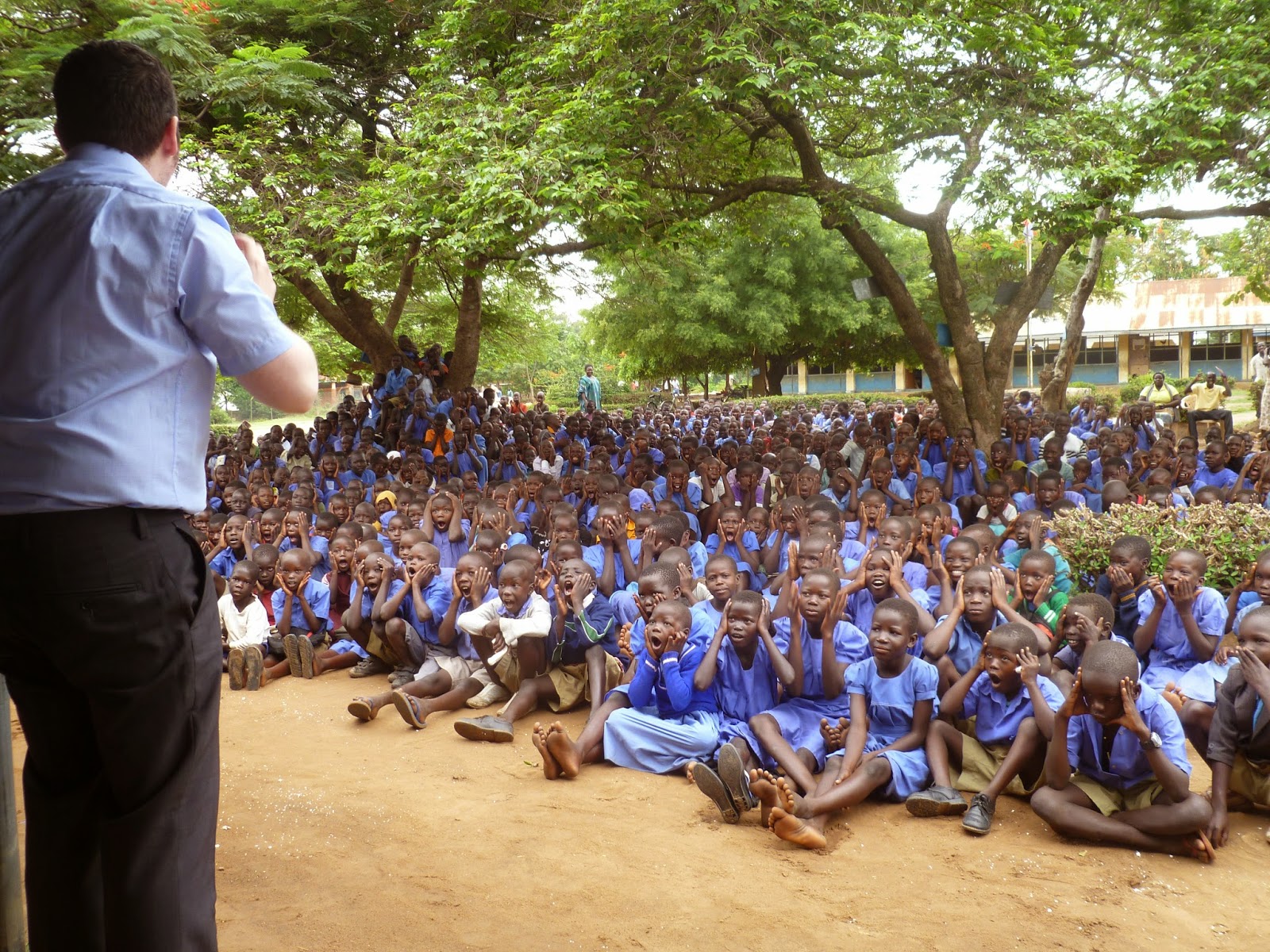
An active listening story: show me your terrified face!


The highlight?  When I visited the sick and administered Holy Communion by extension.  In one morning, we took the sacrament to a sample of ten homes around the cathedral where there were sick and bed-ridden parishioners.  Some were old and immobile; some were barely aware of anyone in the room and had to receive the sacrament spoon-fed with help from a relative.  Some were in mud huts.  All welcomed me in like an honoured guest and offered hospitality in the form of chai or millet porridge.  

Just a small portion for me please, I've already
eaten several times!
I've never experienced hospitality like it.  We soon realized we didn't need to plan lunch.  Everywhere we went we got boiled eggs, groundnuts and milky drinks.  And the 'roast dinner' of Northern Uganda ... we had that a few times a day!  For special occasions like receiving a guest (as well as weddings, farewells, anniversaries), it's a gut-busting, high-carb feast.  You start with a big slice of enyasa, a sort of porridge made with millet.  Then there are potatoes, rice, beans, spinach, cabbage, meat and chicken.  Every part of the animal and bird, nothing wasted.

Ever seen The Vicar of Dibley Christmas Special?  The one where she has to eat four Christmas lunches?  One day, we had that rather heavy meal five times (Sarah had it a sixth)!  I learned that clergy are offered a lot of food and need tactics to decline some politely.

There isn't much to do after dark in Africa.  We were asleep by 8.30 most evenings, safely tucked under the mosquito net, with only the sound of the bats dropping fruit from the trees above our tin roof.  Resting up for the next day.  

Well, that's what happened on weekdays.  Next time, the marathon Sunday services!  
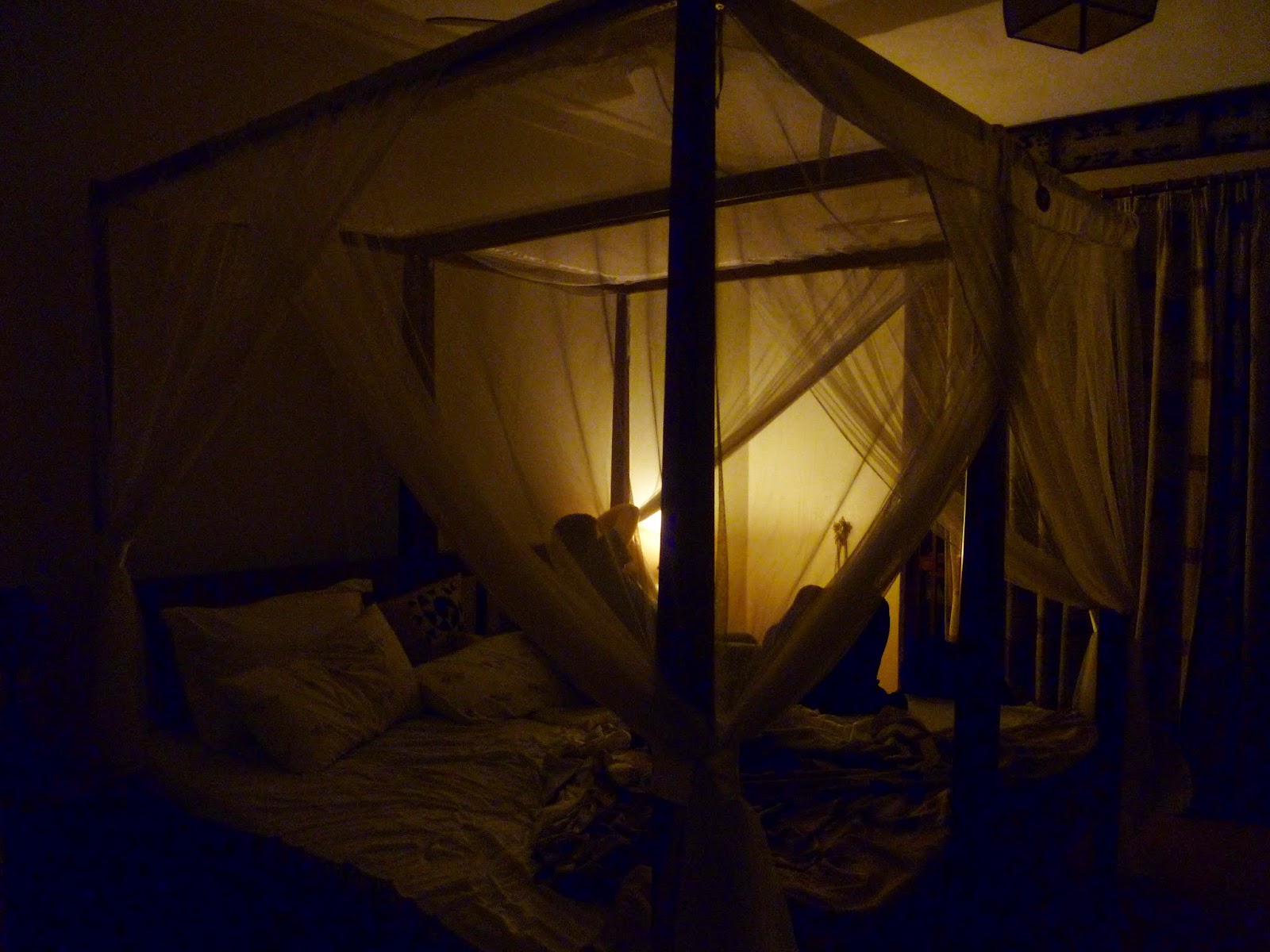
Zzzzzzz.  Not us.  The mosquitoes.

Wednesday, 12 February 2014

Running Wild (16 Weeks To Go)

Marathon training has commenced in style.

On Saturday, I ran in the Wicklow Mountains National Park.  We were in Glendalough for a last-minute mini-break.  Fortunately, the storm-battering that was forecast for the weekend didn't happen.  We had beautiful fresh weather, with even glimpses of the sun.  

Our room overlooked the Monastic City itself.  'City' here means the ruins of a cathedral, round tower, priests' house and a few other ancient buildings, as well as lots of time-eroded standing crosses and gravestones.  Magical.  All dating back to the 6th Century and a certain St. Kevin.

So my first official training run was a bit special.  Across the wooden bridge over the Glendasan River, swollen by the recent rain, was the Monastic City.  There, I turned onto the boardwalk that makes the boggier land accessible, but after the recent rain it felt more like walking on water.  Three deer wandered out from the bare trees, probably forced out into the open by the fact that said trees were waist-height in flood water.

Along the side of the Lower Lake, there were lots of hardy sheep, and hardy tourists too.  The path curved round to the Information Centre, a veritable Hansel and Gretel house, and a much steeper path up to Poulanass waterfall.  Always good to visit waterfalls after heavy rain.

Next it was the edge of the Upper Lake, in a beautiful ice-gashed valley in the recess of Wicklow Gap, along the Old Miners' Road.

Stunning!

Now, I know not every run these next 16 weeks can live up to that first one.  So, my marathon book.  This week's pearl of wisdom is about having an internal locus of control.  That means instead of worrying about all those factors I can't control, I should take charge of what I can make happen.  And do it.

So yesterday, when it was fr-fr-fr-freezing here in Dublin, and I had a New Testament essay to be working on, I'll admit it.  I was tempted to make excuses.  But it's always going to be up to me to make this marathon happen.  So out I went.

This time, in suburban South Dublin.  From the Church of Ireland Theological Institute, it's a skip and a jump to some very nice parkland along the Dodder River.  Not that I ever skip or jump the first 'k' or so of any run.  Those first 10 minutes are often the hardest.  My brain screams that I've eaten too recently, or not wrapped up well enough, or am off my rocker if I ever thought I could run the length of myself.

One great thing about running is learning to ignore the voices in your head that say unhelpful, sometimes quite nasty, stuff.  And having an internal locus of control means you can pretty much make things happen for yourself, and not just accept what you have now.  Yeah yeah I know.  Psycho-babble.

But it works!

So I tried hard to tell myself 'This feels good.  I can do this.  It's getting easier.  I enjoy running.  This makes me feel alive!'  And I actually started believing my own self-induced hype and had a great run!

And it started to snow!  I could barely see a thing in front of me, just the rushy waters of the Dodder beside me and occasional bundled-up figures emerging with dogs.

A second magical run in my first week.  And if I'd looked at the ominous clouds and chickened out, I'd never have had that amazing feeling of running inside a shaken-up snow globe.

Wednesday, 22 January 2014

Doña Cucha's Kitchen

Situated in the fertile breadbasket region in the heart of Bolivia, Cochabambinos get to enjoy the produce of the whole country: giant Andean corn on the cob, delicious sweet potatoes and yuca from the tropical lowlands, meaty surubi fish from tributaries of the Amazon, crunchy whole ispis from Lake Titicaca, grapes from Tarija, ... it's a paradise for lovers of good, natural food.

I lived with the Amestegui family for six months, during which time grandmother Doña Cucha was in charge of the kitchen from Monday to Friday.  Her husband is from La Paz, her daughter-in-law's family from Oruro, but she is a true Cochala in her roots - and her love of good food.

On the few occasions when I cooked for friends, I hid the supermarket receipts from her view.  She could have bought the ingredients much cheaper and probably better quality then I ever could as a gringo in the ferocious La Cancha, the city's huge market, the biggest in Latin America.  
The nerve shattering La Cancha Market

To be honest, I didn't learn much practical technique from her.  I think the idea that a foreign male could ever make a decent sopa de mani or plato paceño tickled her.  Anyways, I'd only have held her back.  Soon after breakfast, when I was starting Spanish lessons for the morning, she was already sitting in the sun peeling broad beans, pounding meat, simmering stock.

Bolivian meals, in the main, are quite simple.  Apart from a few of the hearty soups, most dishes are uncomplicated, with few creamy sauces or fancy accompaniments.  Surprisingly to many visitors, the national cuisine can be quite subtle - rice is gently cooked with a clove of garlic and a piece of green pepper, just to give a hint of the buen sabor.

For example, plato paceño (La Paz lunch plate).  A steamed cob of supersize Andean corn, pale straw-yellow and juicy; some broad beans, a cube of fried cheese, and an assortment of potatoes: a boiled potato, maybe a few ocas (like anyas), and (unfortunately for the uninitiated) chuños, blackening, freeze-dried potato cubes.

Another staple (mostly served on Wednesdays, I think) was plato cubano (Cuban lunch plate).  Rice was mixed with vegetables (carrots, peas), and topped with a fried egg and a few slices of fried plantain.

These dishes were brought to life with a teaspoonful of the fiery llajua, a hot salsa made of tomatoes, onions and the unmistakable bite of local aji chillies.


Now, in one respect, Doña Cucha was not the most typical of Bolivian cooks.  She aimed to make healthy meals, and used a fraction of the oil used in most Cochabamba kitchens, and less meat.  For me, her signature dish was quinoa 'lasagne'.  Her husband Don Lucho took great care to eat well as a preventative medicine.  Every second Bolivian you meet has had or needs to have their gall bladder removed, and/or has terrible gastric problems exacerbated by greasy meals.  So it was when I ate out that I tried the more gut-busting Cochabamba specialities pacumutu, silpancho, and pique a lo macho.

But when I reminisce about Bolivian food, it's Cucha's that I miss.

Looking back on those first six months in Bolivia, some of my happiest memories are around that dining table.  A family, united around traditional, home-cooked food.  All followed by a piece of tropical fruit for dessert (pink mango, chirimoya 'custard apple', pineapple, or papaya), a forceful café destilado, and a little siesta.

Lots of volunteers and missionaries go to Cochabamba to learn Spanish, and many end up staying.  They say it's the eternally spring-like climate that keeps them there - but what tempted me to stay longer was my stomach.


Tuesday, 21 January 2014

Chimichurri

This sauce will change your life!


Ingredients


  • 2-3 long red chillies, seeds removed, finely chopped
  • 10-12 garlic cloves, peeled, finely chopped
  • 2 large handfuls finely chopped curly-leaved parsley, leaves only
  • 4 heaped tsp dried oregano
  • 2 tsp sea salt flakes
  • 5 tbsp red wine vinegar
  • 4-5 tbsp extra virgin olive oil
  • 5 tbsp cold water

Method

1.  Tip the chopped chillies and garlic into a bowl.
2.  Add all remaining ingredients and stir well until combined.
3.  Cover with a sheet of cling film, and leave aside overnight for flavours to come together.

Serve on juicy steak!  (or anything else - chicken, fish, pizza ...)

Monday, 20 January 2014

Re-Run

When I started out blogging, I was a born-again runner.  The evangelical kind of runner who bores anyone who'll listen about tempo, wicking material or pronation.  Pre-conversion, I thought 'pronation' was a Hungarian right-wing bloc.

I made a couple of converts, too.  They probably thought if I can run, anybody can.

After my first-and-only half marathon, with no goal, the running became more and more sporadic.  I tried at college last semester to run three times a week, but soon gave in to the heavy workload and shunned the dark mornings.

New year, new concerted effort.

I've signed up for a marathon.  Bold move, I know.  Potentially foolish, in light of the commitment required and the fact I was high on New Year resolve.  But I've done it now.

Running is as good for the mind as it is for the heart (or indeed waistline).  It's incredible how in the past I managed to push myself when there was that goal of the half marathon.  I had a tick-chart on the fridge door which I initialled and dated after every single run.  It's a mental thing.

So, I'm running regularly again.  I have a tick chart in my room at college.  And a book.  You need a book about running, to run.  If you're me.

I'm laying the ground for the next few weeks.  Not lying on the ground (although I'm forced to do that too after a hard run), but getting back into a routine and getting the old bones and muscles used to moving again, so the next phase isn't such a shock to the system.

Then, according to my book, if I follow the 16 week plan I will finish the Walled City Marathon on 1st June.  It comes with a guarantee.  By that date, if all goes according to plan, I will have finished a second semester of ordination training plus a three-week placement in Uganda.  Dangers along the way include a possible week in France (le vin, le fromage) and the inevitable essay frenzy before Easter.

Thanks for reading - I'm accountable to you now.  If I don't write about running again soon, please ask me what page of the book I'm on.

This is my book, 'The Non-Runner's Marathon Trainer' by
Whitsett, Dolgener and Kole, published by McGraw-Hill, 1998. 

Thursday, 9 January 2014

Turner Prize 2013


At last, Sarah and I made it to the Turner Prize 2013 exhibition, albeit on its last day, in 2014.

Now, last year I went on a guided tour of the Ebrington site and let me tell you, inside those ex-army buildings it was damp, peeling, and not conducive to an appreciation of art.  What they've done to the old barracks to make it such a fantastic gallery space is sheer brilliance.  Hopefully we get to keep it beyond City of Culture year.

Gallery 1 first.  David Shrigley thought the piece for which he was nominated didn't actually work in the gallery, so he exhibited another.  He seems a playful guy who can laugh at himself and tease his critics.  Apparently, he has a rep for not being very good.  So, for the Derry exhibit, he set up a rather roughshod model in the middle of the room, surrounded by chairs, artist's materials at the back.  Yes, it was a life drawing class!  Shrigley's model is designed in deliberately strange proportions - trailing arms, paunch, gaping ears.  The 'finish' isn't elegant.  A mediocre high school art student could have produced the visual.

But of course the 'art' was the experience, the challenge. The most technically brilliant sketcher would inevitably produce a drawing reminiscent of a novice with no feel for perspective, thus levelling out participants and making it accessible, perhaps humbling the artistically proud at the same time.

More fun than attempting my own piece was looking at the ones posted around the gallery.  It wasn't just perspective that bore on individual results, but people seemed to see the same thing albeit from various angles, and yet see something entirely different: some dressed him, coloured him, bent him completely out of shape, in order to represent what they saw, or felt.

Gallery 2 housed the winning installation, Wantee by Laure Prouvost, a French artist resident in North West England.  We entered Grandma's kitchen, full of teapots and dirt.  On the screen we viewed a docu-film about ... well, several strands of narrative, enriched (fragmented?) by interruptions, overlaid voices and captions, noises.  Crucially, we were viewing the film from within the set.  The boundary between fact and fiction, observer and observed, was blurry and in flux as the film rolled.  

Entering an adjacent room, sloping carpeted floor, pink walls on one of which was a small screen with abstract images, another layer was added. What was real, and what was art?  What was mistake and what was deliberate?

We left that one wondering.  Would anyone else have attached the same meanings to things as we had?  Talking that one out, tying up any ends, would have defeated the purpose.  It just felt that disorientation was intended, not as an impetus to understanding, but for its own sake.  

In some ways, the whole Turner Prize thing can seem quite didactic.  Postmodern values are hammered home quite clearly.  The expert is brought low and participation widened.  The line between art and observer is erased, and any notion of correct interpretation is made impossible, even ridiculed.  The whole experience is permeated with a sense of playfulness.  But it comes across as a bit preachy nonetheless.  We are clearly being taught, told; and our questions are left hanging, like they are impertinent attempts to violate and domesticate.

We discerned  a gentler approach in Lynette Yiakom-Boakye's portraits in Gallery 3.  The subjects of her paintings look alive, idiosyncratically enjoying a moment, too real to be representations.  Cloaked in darkness, some in grass, or their own shoulders, there are few clues to their lives and times.  All black, the viewer's suppositions are challenged.  Not daring to stereotype, I found myself readjusting my initial interpretation.  Was I responding to deliberate cues or was I just bringing my own preconceived frames?  

Each portrait hung with no title, no blurb, no date or biography.  Just a painting of a person, and an interpreter, with a space in between to fill.  It was a bit disconcerting to be made so aware of what space there is between reader and text to be filled, and to consider the power of the reader.

The big question always is, 'but is it art?'  Of course it is.  Not the kind you want hanging above your mantelpiece.  

But it got us to react.  Tick.


Monday, 6 January 2014

Cathedral

The Long Walk 
Until the processional hymn started one Sunday recently, I thought it was just a turn of phrase to describe your knees as knocking.  But mine quivered quite definitely as I stepped into the nave of the cathedral, eyes fixed on the prayer desk a long, long way in the distance.

Before Christmas, I was on placement for two months at St Columb's Catherdal here in Derry.  It was a Sunday-only placement, so basically it was in-parish training at leading various bits of services.

I chose St Columb's for several reasons.  Mainly, it's close to home and I already travel 3.5 hours on Sundays during term time.  Also, cathedrals tend to be on the formal side of worship so a good option for learning the 'rules', which later in other parish contexts I might be more inclined to bend.  

St Columb's Catherdal, the highest point in the city,
dedicated to the saint who founded Derry as a monastic site
in the fifth century
The first week, I went along to observe.  The Dean has done an amazing job in these days marked by dwindling congregations -- there were about three hundred regular parishioners there plus visitors.  That's up from when Dean Morton started.  We had a beautifully printed booklet-style order of service.  It was a big service - a Eucharistic celebration marking 400 years of relationship between The Honourable The Irish Society and the walled city it planted here in North-West Ireland.  The Bishop of London was there, the Right Reverend and Right Honorable Richard Chartres DD KVCO to give him his full title.  The civic functions of the Cathedral would be a recurring theme of my later reflections: Remembrance Sunday at the Diamond, the Festival of Nine Carols and Lessons, attended by mayors, councillors, a representative of the Queen even.  That was all quite strange to me, a new-ish Anglican who spent the intervening years in various free churches.

That first visit, I felt a bit like I was in a plane, and we passengers heard voices from the cockpit but we couldn't really see.  Partly because there's an enormous choir at the front between the congregation and the sanctuary where clergy sit, and partly due to beautiful carvings atop each pew end, unfortunately for someone of my little stature, just at eye level.  But our worshipful flight was smooth and at all times I felt myself securely in the hands of people well-trained to do what they do.  The choristers in particular sounded worthy of recording.  It just took some getting used to, joining my prayer to the voices of the 'pros' instead of saying and singing it all congregationally.

A week later, I robed and reported for duty.  And as I say, it was a long, long walk to the front.  That first morning, I reverenced the altar (do they even do that here? there aren't any candles on the altar!) and slipped into my seat at the south end of the altar.  Or as I still like to call it, right turn.  I knew there was a sequence of bowing to my seniors but I didn't even tackle that the first week.

As I said intercessions, I realized I was now the disembodied voice from the front.  It was disconcerting, I thought, not to see the congregation, not to make eye contact.  As always, what most terrifies me is the practical stuff - turning on and off the radio mic is a particular concern of mine; no one needs to hear me strain to sing the melody of the offertory hymn if I forget the off button!

Then, I assisted at communion.  It was the first time in a long time I'd used the first form of the service.  Rather than 'The blood of Christ keep you in eternal life' said to each communicant, it was the wordier (though very lovely) 'The blood of our Lord Jesus which was shed for thee, preserve thy body and soul unto everlasting life; drink this in remembrance that Christ died for thee and be thankful'.  I had the honour of administering the Promise Chalice, and thankfully there were no major mental blocks (although a few people did get an abbreviated version of the words of administration).

Mistakes, I made a good few.  Once when taking the collection plate from the church wardens to give it to the Canon presiding at communion, I trod on my cassock on the step.  There were many kilos of coinage on the very large, solid silver plate and it almost turned ugly.  I learned that sometimes you have to point your toe and step very straight, like a tango move, to avoid a cassock disaster.  Funny the things you need to learn.

Much more importantly, as the weeks passed, I became increasingly aware that as big and important as the cathedral is, it's still a parish church.  The Parish of Templemore takes in a good swathe of the city centre and, crucially, the Fountain, that last Protestant enclave west of the Foyle.  It's where people get baptized, married, have funeral services.  As you enter, as well as carvings and plaques, there's a shopping trolley for donated food items to be distributed.  It's a living community of ordinary people from all walks of life.  It's not primarily a tourist attraction or a museum, or even guardian of the older traditions of the Church of Ireland.  It's a church community.  And a vibrant one at that.

Eight Sundays just wasn't enough, in the end.  I still don't know exactly when to stand/sit/kneel/walk/bow, but that doesn't worry me so much any more.  I know now that cathedral worship is still worship, and a cathedral is still a church.